Home Living
Smart Devices Every Homeowner Should Know
Achieving whole-house smart home functionality requires purchasing a range of devices and accessories to ensure that all home systems function intelligently, thereby improving convenience and comfort. With the increasing prevalence of smart homes, choosing the right devices for different living scenarios has become a focus for many families. Smart homes are not simply about piling up devices; they require systematic planning based on actual needs, space characteristics, and usage habits. Whether it's a newly renovated house or a renovation of an older one, choosing the right devices can significantly improve efficiency and comfort.
Core Living Areas: Living Room, Bedroom, Study, etc.
Basic Control Devices
Smart Switches: Replace traditional switches, supporting mobile app, voice, or automated scene control of lighting.
Smart Curtains: Achieve electric opening and closing via motor, and can be controlled by timers, remotely, or in conjunction with sensors (such as light intensity).
Smart Appliance Control
Infrared Universal Remote Control: Centrally control infrared devices such as TVs, projectors, and air conditioners, solving the problem of multiple remote controls.
Air Conditioner Companion: Upgrades ordinary air conditioners into smart devices, supporting temperature adjustment, mode switching, and energy consumption monitoring.
Smart Speakers
With Infrared Functionality: Control home appliances via voice and offer entertainment features.
Scene-Based Control Devices
Scene Switches: One-button triggering of preset scenes (e.g., "Homecoming Mode" automatically turns on lights, closes curtains, and starts the air conditioner).
Wireless Stickers: Portable buttons that can be attached anywhere to quickly execute specific commands.
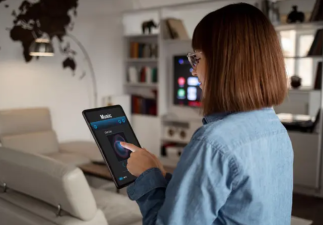
LCD Central Control Screen: Centrally displays and controls all home devices, supporting customizable interfaces and complex scene settings.
Lighting Dimming and Atmosphere Creation
Smart Downlights/Spotlights/Light Strips: Support brightness and color temperature adjustment, suitable for reading, watching movies, and other scenarios.
Smart Bulbs: Directly replace traditional bulbs, enabling remote control or gradient effects.
Voice Interaction Devices
Smart Speakers: Voice control for devices, information retrieval, or music playback.
Infrared Voice Assistants: Voice terminals designed specifically for home appliance control, compatible with non-smart devices.
Multimedia Entertainment
Background Music Host: Distributed music playback, supporting zone control to create an immersive atmosphere.
Security and Sensor Integration
Access Control and Security
Smart Locks: Support fingerprint, password, and remote unlocking via mobile phone; records unlocking history.
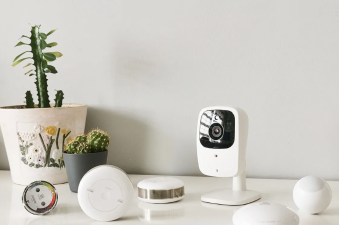
Door Magnetic Sensors: Detect door and window open/close status; trigger alarms or notifications when doors or windows are abnormally opened.
Human Body and Motion Detection
Human Motion Sensors: Detect human activity and trigger lighting, cameras, or alarm systems (e.g., automatically turning on lights when getting up at night).
Kitchen Security and Automation
Environmental Monitoring
Smoke Sensors: Detect fire hazards, promptly alarm, and shut off gas valves.
Gas Sensors: Detect natural gas leaks and trigger exhaust fans or shut off valves.
Water Leak Sensors: Detect water leaks and prevent damage from burst pipes.
Automation Control
Intelligent Robotic Arm: Automatically shuts off valves or switches (e.g., faucets, gas valves).
Smart Bathrooms
Safety Protection
Water Leak Sensors: Detect water leaks and prevent slippery floors or water damage.
Intelligent Robotic Arm: Controls faucets or exhaust fans, reducing manual operation.
Convenient Lighting
Human Body Sensor + Voice-Controlled Lighting: Non-smart devices use sensors to achieve "lights turn on when someone is present, lights turn off when someone leaves."
Core Devices for Whole-House Integration
Smart Gateway: Acts as a central hub, connecting devices using Zigbee, Wi-Fi, and other protocols to ensure stable communication.
Central Control Unit: Integrates scene management, device control, and data analysis functions, supporting cross-brand device compatibility.
Extended Function Devices
Environmental Monitor: Displays real-time data such as temperature, humidity, and PM2.5, and can be linked to fresh air systems or air conditioning.
Smart Camera: Allows remote monitoring of the home, supporting motion tracking and anomaly alarms.
Smart Mattress/Pillow: Monitors sleep quality and can be linked to lighting or air conditioning to adjust comfort.
Summary
The whole-house smart device system covers four major scenarios: control, security, environment, and entertainment. The core logic involves collecting data through sensors, which is then analyzed by the gateway or central control unit to trigger automated commands (such as "away mode" to automatically turn off lights, appliances, and activate security systems). Users can choose a basic package (lighting + curtains + speakers) or an advanced solution (sensors + security + health monitoring) according to their needs, achieving an upgrade from "manual operation" to "seamless interaction".